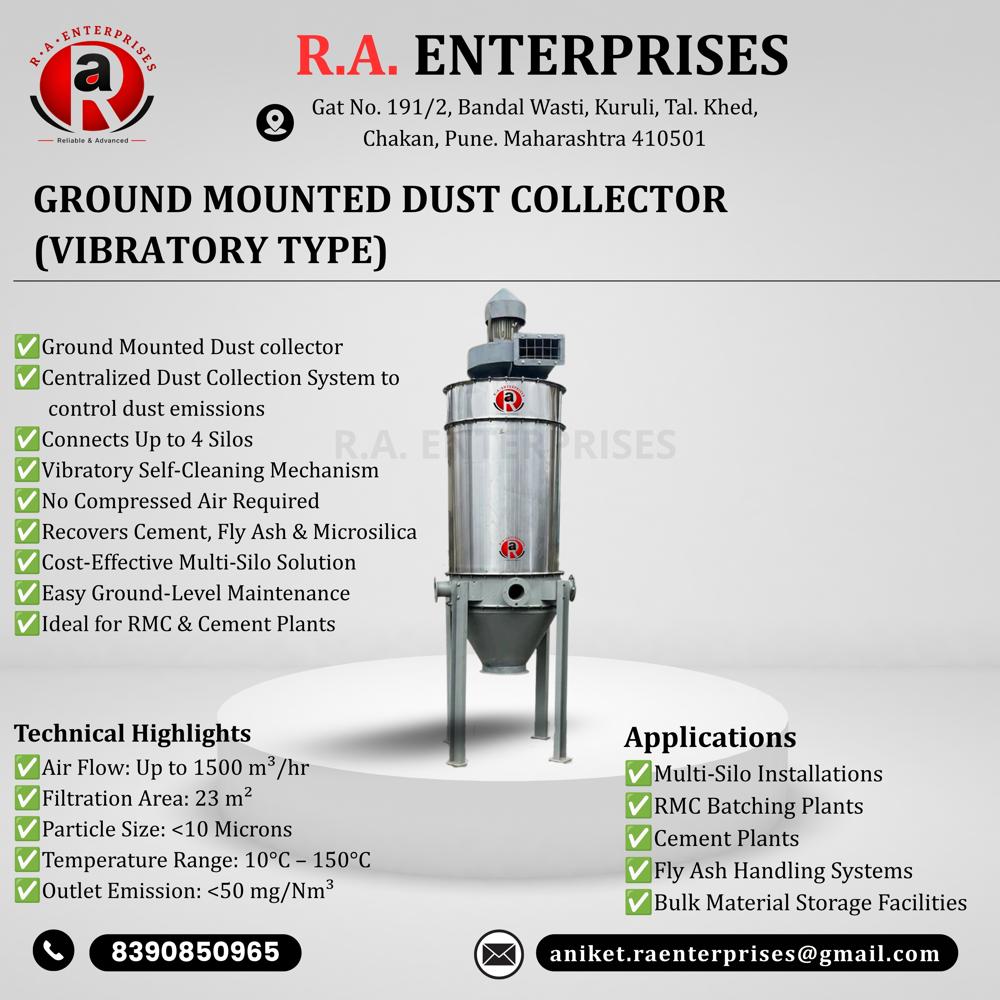
It is a centralized industrial dust collector containing twenty-five filter bags and an automatic compressed-air cleaning arrangement. The unit is installed at ground level and connected to silos, conveyors, hoppers or transfer points through suction ducting.
A blower draws dust-laden air into the filter chamber. Dust is captured on the outer surface of the filter bags, while clean air passes through. Short reverse pulses of compressed air remove accumulated dust from the bags and allow it to fall into the collection hopper.
Reverse-air-jet cleaning uses compressed air directed opposite to the normal filtration airflow. The sudden air pulse flexes the filter bag and removes the accumulated dust layer.
The terms are often used for compressed-air filter-cleaning systems. In this application, short reverse pulses of compressed air are used to clean the filter bags during operation.
It means that twenty-five filter bags or filter elements are installed inside the unit. The actual filtration area depends on the diameter, length and design of the bags.
When the same filter-bag size and media are used, a 25-bag unit generally provides greater filtration area than a 14-bag unit. Final capacity must still be confirmed from airflow, dust loading and pressure-drop calculations.
It may be selected for higher airflow, greater dust loading, multiple extraction points or longer operating periods where a smaller filter does not provide sufficient filtration area.
It can be used at cement plants, ready-mix concrete plants, batching plants, dry-mix plants, fly ash handling plants, bag-dumping stations, conveyors and powder transfer points.
Yes. A ground-mounted centralized dust collector can be connected to multiple silos using correctly sized ducting, dampers and isolation valves.
A complete system may include the filter chamber, twenty-five filter bags, pulse pipes, compressed-air tank, solenoid valves, sequential controller, collection hopper, blower, motor, ducting and dust-discharge valve.
The blower generates suction and draws dust-laden air from the connected equipment into the dust collector. Its capacity must be matched to the total airflow and system pressure loss.
The pulse controller activates the solenoid valves in sequence so that groups of filter bags are cleaned at predetermined intervals.
Yes. A reverse-air-jet or pulse-jet system can be designed for online cleaning, allowing filtration to continue while individual rows of bags are cleaned.
Official Cosben information describes reverse-air-jet ground-mounted filters as online cleaning systems using compressed-air pulses, a hopper, blower and discharge valve.
The operating pressure depends on the pulse-valve, air-header and filter design. The manufacturers specified pressure should be followed instead of applying one universal setting.
Moist compressed air can cause cement dust to stick to the filter bags, block pulse valves and form hardened material inside the dust collector.
Filter media should be selected according to dust-particle size, material abrasiveness, moisture, temperature, chemical compatibility and required outlet emission level.
A dust collector may be designed with bags, cartridges or pleated filter elements. The correct option depends on filtration area, dust properties, maintenance access and equipment design.
The air-to-cloth ratio compares the airflow passing through the dust collector with the total filter-media area. It is an important factor when selecting the number and size of filter bags.
It helps operators monitor filter resistance. High differential pressure may indicate blocked bags or insufficient cleaning, while unusually low pressure may indicate damaged bags or air leakage.
Collected material falls into the hopper and may be removed using a butterfly valve, slide gate, rotary airlock, screw conveyor or other suitable discharge equipment.
Clean collected cement or fly ash can often be returned to the process. Reuse should be avoided if the dust has become contaminated by other materials.
Possible causes include torn bags, loose bag cages, damaged seals, incorrect installation, excessive airflow or unsuitable filter media.
Possible causes include blocked filter bags, insufficient pulse pressure, damaged solenoid valves, a blocked pulse pipe, moisture, excessive dust loading or an incorrectly sized filter.
Yes, provided the body, electrical components, blower and pulse-cleaning equipment have suitable weather protection and corrosion protection.
The hopper should be emptied before accumulated dust reaches the filter bags or blocks the discharge outlet. The required frequency depends on the dust load and hopper size.
Inspect the filter bags, bag cages, pulse valves, solenoid valves, air tank, pressure regulator, blower, bearings, hopper, discharge valve, differential pressure gauge and control panel.
The price depends on filtration area, bag material, blower capacity, body construction, pulse-cleaning equipment, hopper, discharge valve, ducting and automation requirements.
Yes. RA Enterprises manufactures and supplies customized 25-bag reverse-air-jet dust collectors for cement, fly ash and industrial powder-handling applications.
Please provide the material, required airflow, dust loading, number of suction points, conveying distance, operating temperature, filter-media preference, blower requirement, discharge arrangement and installation location.
Ground-mounted dust collector 25 bag
25-bag dust collector
25-bag baghouse filter
25-bag pulse-jet dust collector
25-bag reverse-air-jet dust collector
Ground-mounted reverse-air-jet filter
Ground-mounted pulse-jet filter
Industrial pulse-jet bag filter
Reverse-pulse baghouse
Compressed-air bag cleaning system
Online cleaning dust collector
Continuous-operation dust collector
Centralized industrial dust collector
Multi-silo dust collector
Cement silo centralized filter
Dust collector for cement silos
Cement plant bag filter
Cement dust extraction system
Industrial dust extraction system
Dust collection and filtration system
Dust removal system
Dedusting plant
De-dusting equipment
Dust filtration technology
Industrial air and dust filtration
Filter dust collector
Bag filter dust collector
Cartridge filter dust collector
Pleated filter element dust collector
Dust collector with blower
Dust collector with industrial fan
Dust collector with hopper
Dust collector with butterfly valve
Dust collector with rotary valve
Pulse-jet controller
Dust collector solenoid valve
Compressed-air header for dust collector
Dust collector bag cage
Differential pressure gauge for bag filter
Differential pressure monitoring system
Material recovery system
Cement dust recovery system
Fly ash collection system
Powder transfer-point dust collector
Conveyor dedusting system
Bag-dumping-station dust collector
RMC batching plant dust collector
25-bag dust collector price in India
25-bag dust collector manufacturer in India
Reverse-air-jet dust collector manufacturer in Pune
Industrial bag filter supplier in Pune
A ground-mounted 36-bag reverse-air-jet dust collector is a high-capacity centralized dust-filtration unit containing thirty-six filter bags. It uses automatic compressed-air pulses to clean the filters and is suitable for industrial installations with higher airflow or dust loading.
An industrial blower draws dust-laden air into the collector. Dust particles are retained by the filter bags, and clean air exits through the clean-air chamber. Sequential compressed-air pulses remove accumulated dust, which falls into the collection hopper.
It means that thirty-six filter bags or filter elements are installed inside the filter chamber. Filter-bag count, dimensions and media together determine the total filtration area.
It may be selected when the required airflow, number of suction points, dust load or operating duration is greater than the capacity of a smaller 14-bag or 25-bag system.
When both units use the same filter-bag size and media, the 36-bag model generally provides more filter area. However, blower selection, ducting and cleaning performance also determine the complete system capacity.
Its larger filtration area can support higher airflow, lower filter loading and longer operation between maintenance intervals when correctly designed for the application.
It is suitable for cement plants, multiple cement silos, large batching plants, fly ash handling, dry-mix plants, mineral-powder handling, conveyors, transfer towers and centralized dust-extraction systems.
Yes. The collector can be connected to multiple silos or dust-generation points using an engineered duct network, dampers and isolation valves.
Yes. Reverse-air-jet or pulse-jet cleaning can clean selected filter rows while the remaining bags continue filtering, supporting continuous online operation.
A venting filter releases displaced air from a silo while retaining dust. A suction dust collector uses a fan or blower to actively draw dusty air from connected equipment through ducting.
WAMGROUP describes industrial dust collectors as suitable for venting, suction and vacuum applications, with bag, cartridge or pleated filter elements and automatic pulse-jet cleaning.
The system may include a filter chamber, thirty-six filter bags and cages, compressed-air header, pulse valves, sequential controller, clean-air chamber, hopper, support structure, blower, motor, discharge valve and ducting.
The blower is selected from total airflow, static pressure loss, duct resistance, filter pressure drop, number of suction points and required capture velocity.
Only when the system is designed for the additional airflow. An oversized blower can increase power consumption, damage filter bags, draw excessive material and create high pressure drop.
The correct filter media depends on material type, particle size, temperature, moisture, abrasiveness and required filtration efficiency. Standard polyester, antistatic or other specialized media may be considered according to the application.
Only when the body, filter bags, seals and accessories are selected for the actual operating temperature. Standard filter media should not be used above its rated temperature.
A standard cement dust collector should not automatically be considered suitable for combustible or explosive dust. Such applications require a dedicated hazard assessment and appropriately certified explosion-protection design.
Bag cages support the filter bags against the airflow and help maintain their shape during filtration and pulse cleaning.
The air header stores compressed air and supplies the pulse valves with sufficient air for rapid filter-cleaning pulses.
It is an electrical controller that activates the pulse valves in a programmed sequence. Cleaning can be time-based or controlled according to differential pressure.
The controller starts or adjusts filter cleaning when the measured pressure difference across the filter bags reaches a selected limit. This can reduce unnecessary compressed-air consumption.
High differential pressure may result from blocked bags, insufficient cleaning pressure, failed pulse valves, moisture, excessive airflow, excessive dust loading or inadequate filtration area.
Possible reasons include torn filter bags, missing bags, loose seals, an open inspection door, incorrect gauge connections or insufficient airflow.
Dust may be discharged through a rotary airlock, butterfly valve, slide gate, screw conveyor or double-dump valve, depending on the required operating method.
A rotary airlock allows collected dust to discharge while helping maintain suction or negative pressure inside the dust collector.
Yes. Cement, fly ash or mineral powder may be recovered and reused when it remains uncontaminated and suitable for the production process.
Common causes include a blocked discharge valve, insufficient hopper angle, moisture, material bridging, infrequent emptying or failure of the rotary valve or screw conveyor.
Use a suitable hopper angle, regular discharge cycle, bin aerator, vibrator or other flow-aid device selected for the stored material.
Inspection frequency depends on operating hours, dust loading, pressure-drop trends and material characteristics. Visual inspection should be included in the regular preventive-maintenance schedule.
Filter-bag life depends on filter media, dust abrasiveness, temperature, moisture, airflow, cleaning intensity and maintenance. There is no single service-life value suitable for every application.
Yes. The body size, filtration area, bag dimensions, filter media, blower capacity, hopper design, discharge valve, inlet position and control panel can be customized.
The price depends on filter-media area, body material, blower capacity, pulse valves, control system, hopper, support structure, dust-discharge equipment, ducting and site requirements.
Yes. RA Enterprises manufactures customized 36-bag reverse-air-jet dust collectors for cement plants, batching plants, multiple silos and industrial powder-handling systems.
Please provide the material, required airflow, dust concentration, operating temperature, number of suction points, duct length, filter-media requirement, blower details, hopper-discharge arrangement, automation requirement and project location.
Ground-mounted dust collector 36 bag
36-bag dust collector
36-bag industrial bag filter
36-bag reverse-air-jet dust collector
36-bag pulse-jet dust collector
High-capacity dust collector
Heavy-duty industrial dust collector
Large-capacity baghouse filter
Centralized dust extraction system
Centralised dust collector
Multi-point dust collection system
Multi-silo dust collection system
Cement silo centralized dust collector
Cement plant baghouse filter
Concrete batching plant dust collector
RMC plant dust extraction system
Fly ash handling dust collector
GGBS plant dust collector
Lime plant dust collector
Mineral-powder dust collector
Dry-mix mortar plant dust collector
Powder-handling dust collection system
Conveyor dust extraction system
Transfer tower dust collector
Transfer-point dedusting system
Bag-dumping dust collector
Industrial pulse-jet bag filter
Reverse-air cleaning bag filter
Reverse-pulse dust collector
Online filter-cleaning system
Continuous dust-filtration system
Compressed-air pulse-cleaning system
Dust collector filter bags and cages
Bag filter pulse valve
Dust collector solenoid valve
Sequential pulse controller
Differential-pressure-controlled cleaning
Dust collector pressure-drop monitoring
Industrial suction blower
Dust collector exhaust fan
Dust collector filter hopper
Dust collector rotary airlock valve
Dust collector screw conveyor
Material recovery dust collector
Cement dust recovery plant
Industrial air-filtration system
Dust removal equipment
Dedusting equipment
De-dusting plant
Dust filtration plant
Industrial dust-control equipment
Low-emission dust collector
Weatherproof industrial dust collector
36-bag dust collector price in India
36-bag dust collector manufacturer in India
High-capacity dust collector manufacturer in Pune
Industrial reverse-air-jet filter supplier in Pune
25 Bag Silo Dust Collector Manufacturer in Pune
R.A. Enterprises manufactures 25 bag ground-mounted silo dust collectors for cement, fly ash and RMC batching plants with efficient reverse air-jet cleaning.
The 25 Bag Ground-Mounted Silo Dust Collector from R.A. Enterprises is designed for efficient dust extraction in cement silos, RMC batching plants and bulk powder handling systems.
The unit captures fine dust generated during cement unloading, silo feeding, screw conveyor discharge and material transfer operations. Dust-laden air is drawn into the filter chamber, where the filter bags retain cement, fly ash and other fine particles while allowing filtered air to discharge from the system.
Its reverse air-jet cleaning mechanism periodically removes accumulated dust from the filter bags, helping maintain consistent airflow and reducing manual filter cleaning. The separated material is collected in the integrated bottom hopper for controlled disposal or recovery.
Manufactured with a heavy-duty mild-steel body, the dust collector is suitable for continuous industrial operation and can be customized according to the required airflow, filtration area, dust characteristics and installation layout.
25 high-performance filter bags
Reverse air-jet filter cleaning system
Ground-mounted industrial design
Heavy-duty mild-steel construction
Integrated dust collection hopper
Efficient extraction of fine powder
Easy filter inspection and replacement
Reduced dust leakage and material loss
Suitable for continuous industrial use
Customized configurations available
Cement silo unloading systems
Ready-mix concrete batching plants
Fly ash handling systems
Screw conveyor discharge points
Cement feeding and transfer systems
Dry-mix mortar plants
Lime and gypsum powder handling
Bulk powder loading and unloading
Industrial material transfer points
A 25 bag silo dust collector is an industrial filtration system equipped with 25 filter bags. It captures fine dust generated during cement unloading, material feeding and bulk powder transfer operations.
This model is installed at ground level and connected to the silo unloading point, screw conveyor, feeding system or other dust-generating material transfer locations.
The cleaning system sends controlled air pulses through the filter bags. These air pulses dislodge accumulated dust from the filter surface and allow it to fall into the collection hopper.
It can be used for cement, fly ash, lime powder, gypsum, mineral powder and other dry, non-sticky bulk materials. Filter media must be selected according to the material and operating conditions.
Yes. The 25 bag dust collector is suitable for controlling dust generated around cement silos, screw conveyors, weigh hoppers and material transfer points in RMC batching plants.
A silo-top dust collector vents displaced air directly from the top of the silo. A ground-mounted dust collector is normally connected through ducting to unloading, feeding or material transfer points and collects separated dust inside a hopper.
Selection depends on required airflow, number of extraction points, type of powder, dust concentration, conveying method, operating temperature, duct length and allowable pressure drop.
Cleaning frequency depends on dust loading and operating hours. Filter bags should be inspected regularly and replaced when they are damaged, blocked or unable to maintain the required airflow.
Yes. R.A. Enterprises can customize the filtration area, bag material, blower capacity, hopper arrangement, inlet size, outlet position, control panel and overall dimensions according to the application.
Please provide the material being handled, required airflow, number of extraction points, silo or equipment details, operating hours, available electrical supply and installation layout.
25 bag dust collector
Cement silo dust collector
Ground mounted dust collector
Silo dust collector manufacturer
Silo dust collector manufacturer in Pune
RMC plant dust collector
Batching plant dust collector
Reverse air jet dust collector
Cement silo bag filter
Industrial dust collector manufacturer in India
Fly ash dust collector
Bag filter dust collector for cement plant


Price: