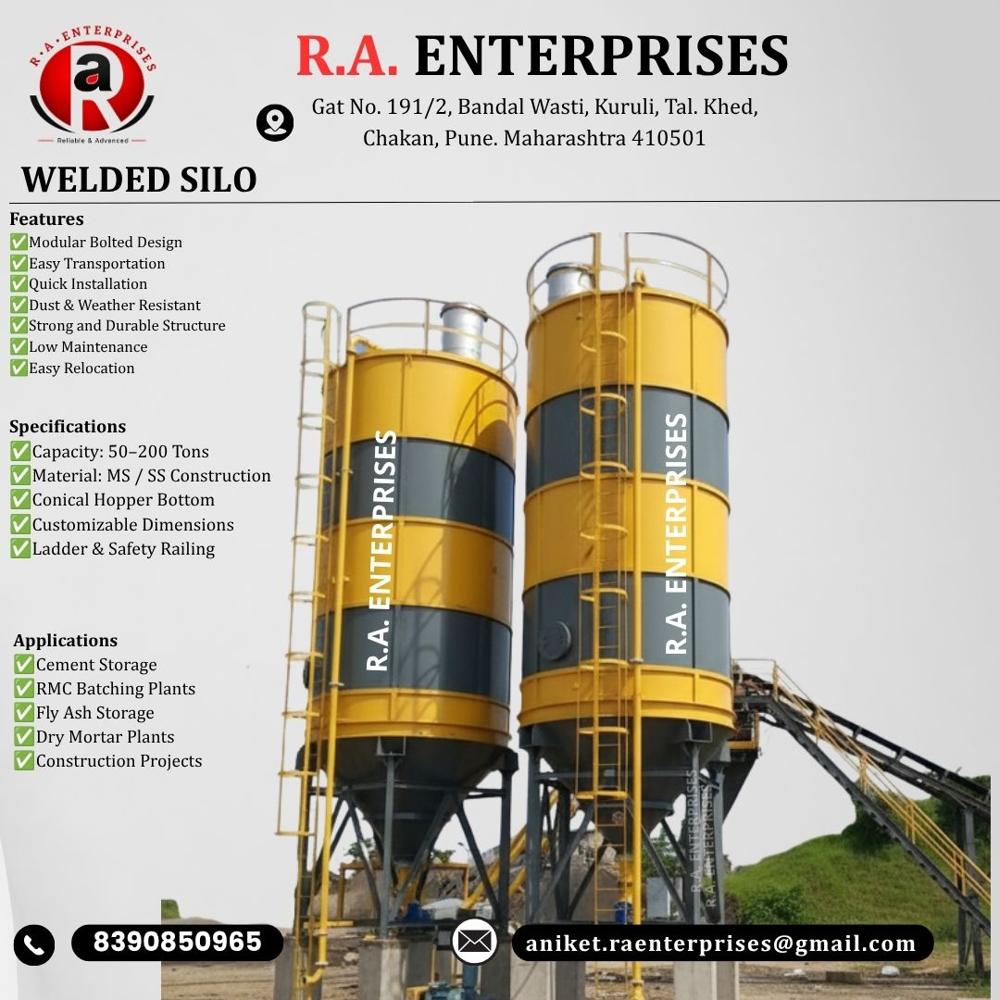
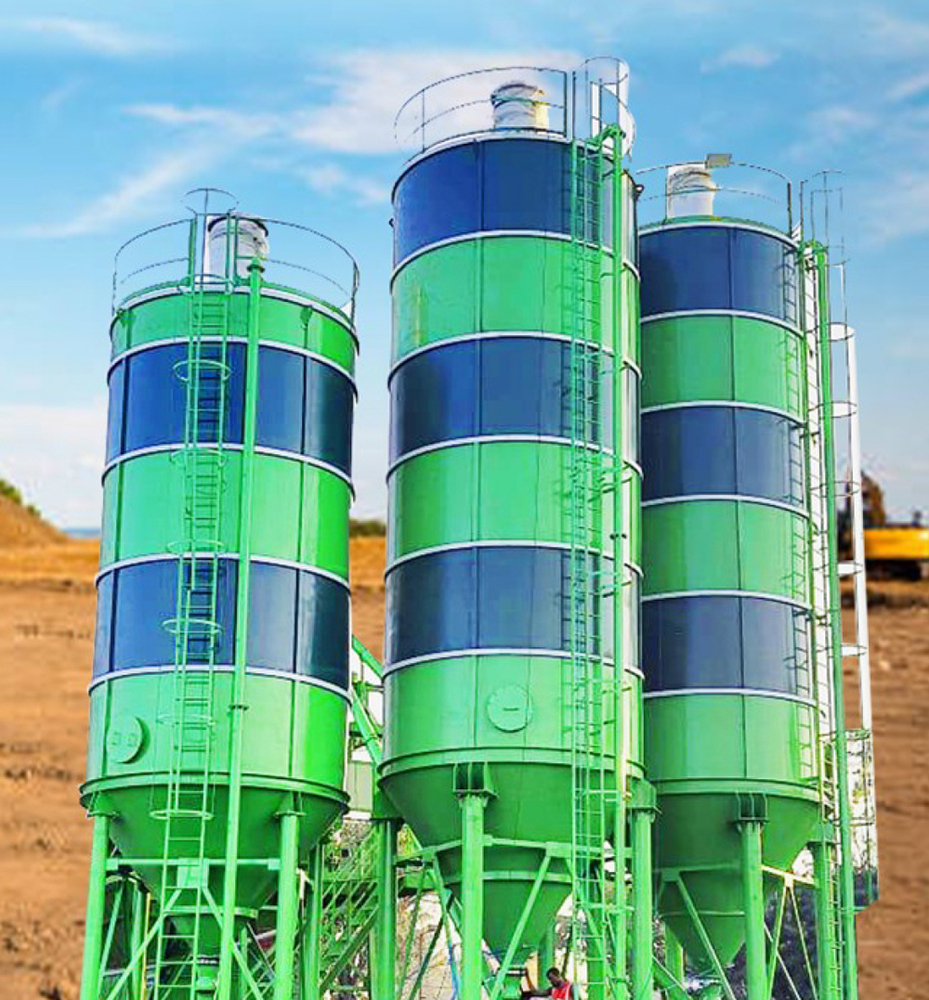
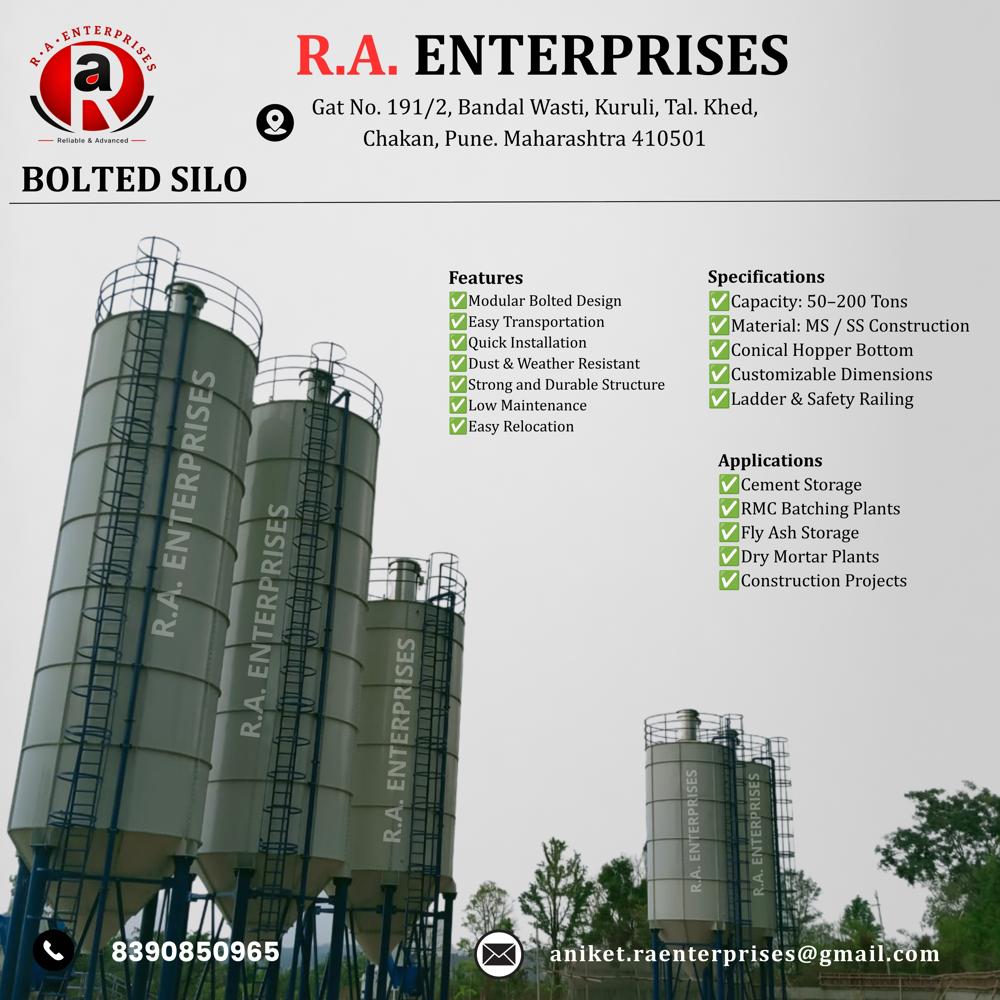
A welded cement silo is a fully fabricated steel storage container used for storing bulk cement at concrete batching plants, construction sites and industrial facilities. Its body and cone sections are permanently joined by welding.
Cement is transferred from a bulk tanker into the silo through a filling pipe using compressed air. The cement is stored inside the sealed silo and discharged from the bottom cone through a butterfly valve and screw conveyor.
The price of a welded cement silo depends on its storage capacity, steel thickness, silo diameter, height, accessories, transportation distance and installation requirements. Customers should share their technical requirements and site location to receive an accurate quotation.
Welded cement silos are commonly manufactured in capacities such as 30 tonnes, 40 tonnes, 50 tonnes, 60 tonnes, 80 tonnes and 100 tonnes. Customized capacities can also be manufactured depending on transportation limits and site requirements.
A welded silo is manufactured as a single complete structure and transported directly to the site. A bolted silo is manufactured in separate sections and assembled at the installation location.
A welded silo is generally suitable for nearby project locations where transportation is convenient. A bolted silo is more suitable for long-distance transportation, export projects and sites with restricted access. The best option depends on capacity, distance and site conditions.
A welded cement silo offers faster site installation, fewer assembly joints, strong structural construction and reliable protection against moisture when properly manufactured and maintained.
Yes. Welded cement silos are widely used with concrete batching plants for storing cement and supplying it continuously through a screw conveyor.
The correct capacity depends on your batching plant output, daily cement consumption, frequency of cement delivery and available installation space. It is advisable to keep sufficient storage capacity to avoid production stoppages.
The dimensions of a 50-ton welded silo depend on its diameter, cylindrical height, cone design and required discharge height. Final dimensions are prepared according to the manufacturers design and transportation limitations.
A 100-ton welded silo is larger in diameter and height than a 50-ton silo. Its exact dimensions depend on cement density, usable capacity, structural design, site space and transportation feasibility.
Yes. The silo diameter, height, supporting-leg height, discharge clearance and accessory arrangement can be customized according to the batching plant layout and site conditions.
Plate thickness varies across the cylindrical body, cone, roof and supporting structure. It is selected based on silo capacity, diameter, material pressure, wind load, structural calculations and applicable safety requirements.
Welded cement silos are generally manufactured using suitable structural-grade mild steel plates. The selected material grade and thickness depend on the capacity and engineering design.
A properly manufactured welded silo provides good protection against rain and moisture. Welding joints, roof covers, filling connections, inspection covers and gaskets must be properly sealed and inspected regularly.
Common accessories include a silo dust collector, pressure relief valve, high-and-low-level indicators, aeration system, butterfly valve, filling pipe, ladder, maintenance platform and screw conveyor.
Yes. A suitable screw conveyor can be supplied according to the required length, diameter, inclination, discharge height and batching plant capacity.
A welded silo is generally transported as a complete fabricated structure using a suitable trailer. Transportation feasibility depends on the silo diameter, height, weight, route restrictions and site accessibility.
The maximum transportable size depends on local road regulations, bridge clearances, route conditions and trailer availability. Large-capacity silos may need a bolted or site-fabricated design instead of a fully welded design.
The silo is lifted using a suitable crane and positioned on the prepared foundation. It is aligned with the anchor bolts, secured properly and connected to the filling pipe, screw conveyor, electrical system and accessories.
The foundation depends on the silos total loaded weight, supporting-leg arrangement, wind load, seismic conditions and soil-bearing capacity. The foundation must be designed and approved by a qualified structural or civil engineer.
The required space depends on the silo diameter, supporting structure, screw conveyor arrangement, tanker access and maintenance clearance. Sufficient working space should also be kept for crane movement and installation.
Manufacturing time depends on the silo capacity, customization, accessories and production schedule. Delivery and installation time also depend on transportation distance and site readiness.
Yes, but relocation requires careful dismantling of connected equipment, suitable lifting arrangements and safe transportation. The foundation and structural condition should be checked before reinstalling the silo.
Yes. A welded silo can be designed to store fly ash, lime, GGBS, gypsum and other dry powder materials. The material density, flow characteristics and moisture sensitivity must be considered during design.
Blockage can be reduced by using a properly designed cone, aeration pads, air jets or vibrators. The cement should be protected from moisture, and the outlet system should be inspected and operated regularly.
Welded joints should be visually checked for cracks, corrosion, leakage and deformation. Important structural joints should be inspected using an appropriate testing method whenever required by the design or quality plan.
The silo should be inspected regularly according to its operating conditions. The dust collector, pressure relief valve, level indicators, aeration system, butterfly valve, screw conveyor, welding joints and supporting structure should be checked periodically.
The service life depends on material quality, fabrication workmanship, operating conditions, protective coating and maintenance. Regular inspection and timely repairs can significantly increase the silos working life.
RA Enterprises manufactures and supplies welded cement silos and concrete batching plant equipment from the Pune region. Customers can share their required capacity, site location and technical requirements to receive a quotation.
Yes. RA Enterprises can manufacture welded cement silos according to the required storage capacity, discharge height, batching plant layout, accessory requirements and site conditions.
Please provide the required storage capacity, material to be stored, batching plant capacity, project location, discharge height, silo accessories, screw conveyor requirement and expected delivery timeline.


Price:
Price 515000.0 INR / Unit
Minimum Order Quantity : 1 Unit
Usage : Storage
Application : Industrial
Warranty : Yes
Bottom Type : Cone
Price 450000 INR / Unit
Minimum Order Quantity : 1 Unit
Usage : Storage
Application : Industrial
Warranty : Yes
Bottom Type : Cone