A screw conveyor geared motor is an integrated electric motor and gearbox assembly used to rotate the internal screw at the required speed and torque.
A gear reducer is a mechanical transmission unit that reduces the electric motors rotational speed and increases the available output torque.
A geared motor combines the electric motor and reduction gearbox into one drive assembly.
A gear reducer is only the gearbox and requires a separate electric motor or another power source.
An electric motor normally rotates much faster than the speed required by the conveyor screw. The gear reducer lowers this speed and increases torque so the conveyor can move the required material load.
The motor rotates the input shaft of the gearbox. The internal gears reduce the speed and transfer increased torque to the gearbox output shaft, which is connected to the conveyor drive shaft.
It may also be called a gearmotor, motor gearbox, reduction geared motor, geared drive, conveyor drive unit, speed reducer or screw conveyor drive.
Common types include:
Helical gear reducer
Bevel-helical gear reducer
Parallel-shaft helical reducer
Worm gear reducer
Shaft-mounted reducer
Inline gear reducer
Right-angle gear reducer
Planetary gear reducer
The correct type depends on torque, space, mounting position and efficiency requirements.
A helical geared motor uses angled gear teeth to provide smooth power transmission, good efficiency and relatively low operating noise.
A bevel-helical gearbox changes the direction of power transmission, normally by approximately 90 degrees, while providing efficient speed reduction and high torque.
A parallel-shaft geared motor has input and output shafts positioned parallel to each other. Its compact shape can be useful where installation space is limited.
A worm gearbox uses a worm and worm wheel to provide a high reduction ratio in a compact right-angle arrangement. Its efficiency and thermal capacity should be checked for continuous heavy-duty conveying.
The best option depends on the screw diameter, length, inclination, required capacity, starting load, operating hours, output speed, torque and installation space.
Motor power is selected from the conveyor length, inclination, material bulk density, required capacity, friction, bearing resistance, screw diameter and starting condition.
The output speed is selected according to the required screw revolutions per minute. It depends on conveyor diameter, screw pitch, material properties, inclination and required capacity.
The reduction ratio is the relationship between the motor input speed and gearbox output speed.
For example, a higher ratio produces a lower output speed and generally higher output torque.
Output torque is the rotational force available at the gearbox output shaft. It must be sufficient to start and operate the screw conveyor under the expected material load.
Service factor is an allowance used when selecting a gearbox for operating hours, load variation, shock loading, starts per hour and application severity.
It can only do so when the motor, gearbox, coupling and electrical starter are designed for the required starting torque. Frequent starts under full load can increase mechanical and electrical stress.
A direct-drive screw conveyor has the geared motor connected directly to the conveyor drive shaft through a flange, coupling or adaptor.
A chain-drive arrangement uses sprockets and a roller chain to transfer power from the gearbox to the conveyor shaft.
Direct drive is compact and reduces the number of external transmission components.
Chain drive provides greater flexibility in motor position and speed ratio but requires chain alignment, tensioning, lubrication and guarding.
A shaft-mounted reducer is installed directly on the conveyor drive shaft. A torque arm prevents the gearbox housing from rotating during operation.
A torque arm supports a shaft-mounted gearbox and reacts against the rotational force produced by the drive.
Only when the selected gearbox is approved for the required mounting position. Mounting orientation affects lubrication level, breather position and internal oil distribution.
Incorrect mounting can prevent proper lubrication of the gears and bearings, causing overheating, leakage and premature gearbox failure.
Geared motors may be supplied for different voltages, frequencies and single-phase or three-phase electrical systems. The motor rating must match the site supply.
Yes. A variable-frequency drive can control motor speed and allow controlled conveyor starting, provided the motor and gearbox are suitable for the operating speed range.
Yes. Changing screw speed changes the theoretical conveying rate. However, operating outside the designed speed range can cause overfeeding, wear, material fallback or motor overload.
A soft starter reduces the electrical and mechanical shock during motor starting by gradually increasing the supplied voltage.
Common protections include:
Short-circuit protection
Motor overload protection
Phase-failure protection
Phase-sequence protection
Under-voltage protection
Over-temperature protection
Emergency stopping
Proper earthing
Possible causes include:
Screw conveyor blockage
Excessive material feeding
Incorrect overload setting
Low voltage
Phase failure
Seized bearing
Misaligned screw
Damaged gearbox
Insufficient motor power
Hardened cement inside the conveyor
Possible causes include incorrect oil level, unsuitable oil, overloading, incorrect mounting position, excessive ambient temperature, blocked breather, bearing damage or continuous operation beyond the rated duty.
Oil leakage may result from damaged seals, excessive oil level, blocked breather, loose plugs, worn output shaft, incorrect mounting or excessive internal temperature.
Noise may be caused by worn gears, damaged bearings, incorrect oil, loose mounting bolts, coupling misalignment, excessive backlash or conveyor overloading.
Possible causes include motor failure, broken coupling, damaged gear teeth, sheared key, electrical fault or complete screw conveyor blockage.
The correct oil type and viscosity depend on the gearbox design, mounting position, operating temperature, load and manufacturers recommendation.
Oil-change intervals depend on the gearbox model, oil type, operating temperature, operating hours and environmental conditions. The gearbox manufacturers maintenance schedule should be followed.
Yes. Depending on the damage, bearings, oil seals, gears, shafts, motor windings and other components may be repaired or replaced.
Yes, provided the replacement has compatible output torque, speed, service factor, mounting position, shaft dimensions, flange dimensions, electrical rating and duty classification.
The price depends on motor power, reduction ratio, output torque, gearbox type, mounting arrangement, efficiency class, brake requirement and brand.
Yes. RA Enterprises supplies geared motors and reducers for cement screw conveyors, fly ash conveyors, feeders and other industrial material-handling systems.
Please provide:
Screw conveyor diameter
Conveyor length
Conveyor inclination
Handled material
Required conveying capacity
Existing motor power
Motor input speed
Required gearbox output speed
Required output torque, if known
Reduction ratio
Mounting position
Solid or hollow output shaft
Shaft diameter
Flange dimensions
Electrical voltage and frequency
Duty hours per day
Existing nameplate photograph
Quantity
Delivery location
Screw conveyor geared motor
Screw conveyor gearmotor
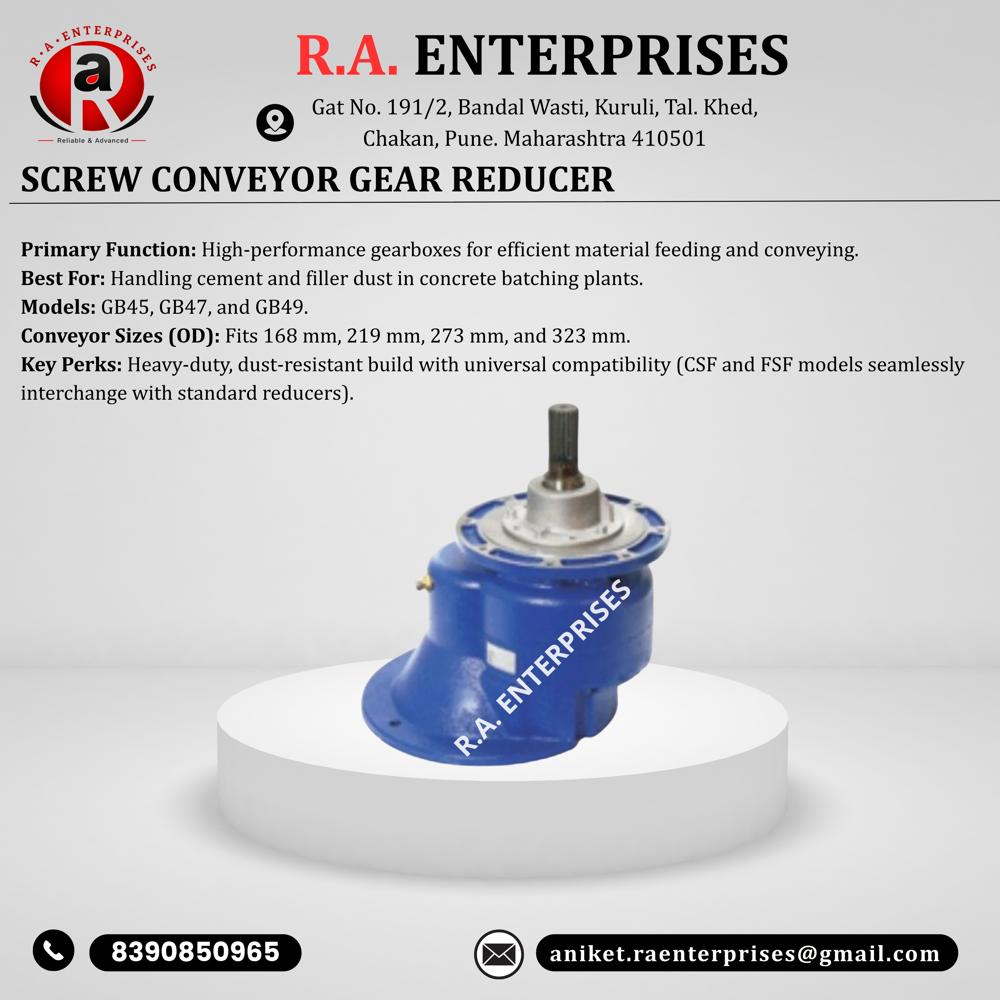
Screw conveyor gear reducer
Screw conveyor gearbox
Cement screw conveyor geared motor
Cement screw conveyor gearbox
Fly ash screw conveyor gearbox
Auger conveyor geared motor
Screw feeder geared motor
Tubular screw conveyor drive
U-trough screw conveyor drive
Conveyor drive unit
Geared motor for screw conveyor
Gear reducer for screw conveyor
Motor gearbox for screw conveyor
Reduction geared motor
Industrial gearmotor
Industrial speed reducer
Helical geared motor
Helical gear reducer
Bevel-helical geared motor
Bevel helical gearbox
Parallel-shaft helical gearmotor
Parallel-shaft gear reducer
Worm geared motor
Worm gear reducer
Inline geared motor
Right-angle geared motor
Shaft-mounted gear reducer
Hollow-shaft geared motor
Solid-shaft geared motor
Flange-mounted geared motor
Foot-mounted geared motor
Direct-drive screw conveyor gearbox
Chain-drive screw conveyor gearbox
Gearbox with torque arm
Screw conveyor drive coupling
Screw conveyor motor coupling
High-torque geared motor
Low-speed high-torque gearbox
Geared motor reduction ratio
Gearbox output torque
Gearmotor output RPM
Screw conveyor motor power calculation
Screw conveyor gearbox selection
Variable-speed screw conveyor
VFD geared motor
Three-phase geared motor
Single-phase geared motor
Heavy-duty conveyor gearbox
Continuous-duty geared motor
Geared motor spare parts
Gearbox oil seal
Gear reducer bearing
Screw conveyor geared motor price in India
Screw conveyor gearbox manufacturer in India
Cement screw conveyor geared motor supplier in Pune
Industrial gear reducer supplier in Pune


Price:
Price 4000.00 INR / Number
Minimum Order Quantity : 1 Number
Features : High Quality
Warranty : Yes
Usage & Applications : Industrial
Surface Finish : Paint Coated
Price 2500.0 INR / Unit
Minimum Order Quantity : 1 Unit
Features : High Quality
Warranty : Yes
Usage & Applications : Industrial
Surface Finish : Polished
Price 3100.0 INR / Meter
Minimum Order Quantity : 1 Meter
Features : High Quality
Warranty : Yes
Usage & Applications : Industrial
Surface Finish : Polished
Price 2350.0 INR / Unit
Minimum Order Quantity : 1 Unit
Features : High Quality
Warranty : Yes
Usage & Applications : Industrial
Surface Finish : Paint Coated